Startup Funding Process Explained: Pre-Funding, During Funding & Post-Funding Guide
By Toishaa Soni · 30 April 2026
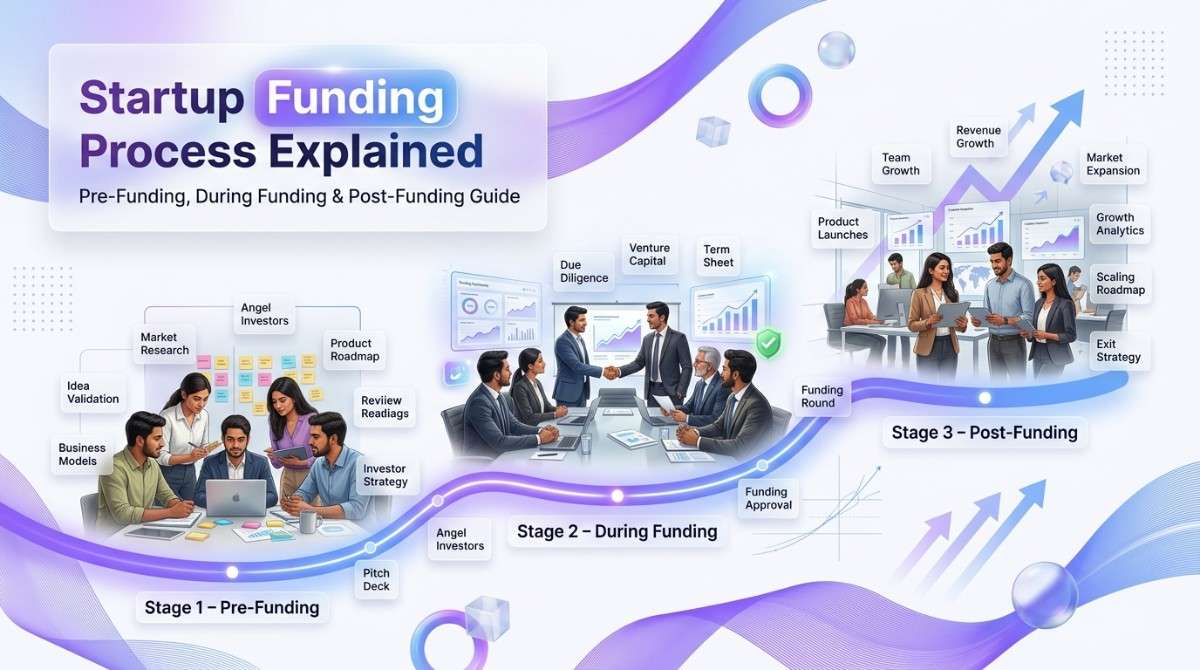
The startup funding process is explained from pre- to post-funding. Learn stages, investor readiness, and compliance tips. Read full guide now.
Most founders think the startup funding process starts with a pitch. It doesn’t.
It starts much earlier with clarity and continues long after the money is raised. In reality, funding is not a one-time event. It is a structured journey where expectations evolve at every stage.
Ask yourself: Are you preparing for funding… or just preparing to pitch?
Because the way investors evaluate you changes as your startup grows. Early investors bet on your vision. Later investors bet on your data and execution.
Understanding this shift is what defines success in fundraising.
Understanding How the Startup Funding Process Works
The startup funding process is not random. It follows a clear progression.
It moves through three key phases: pre-funding preparation, during funding execution, and post-funding management. Each phase builds on the previous one, and skipping any stage creates friction later.
What most founders miss is this: Funding is not about convincing investors. It is about reducing risk step by step. And every stage you move through reduces that risk.
Pre-Funding Preparation: Where Investor Confidence Is Built
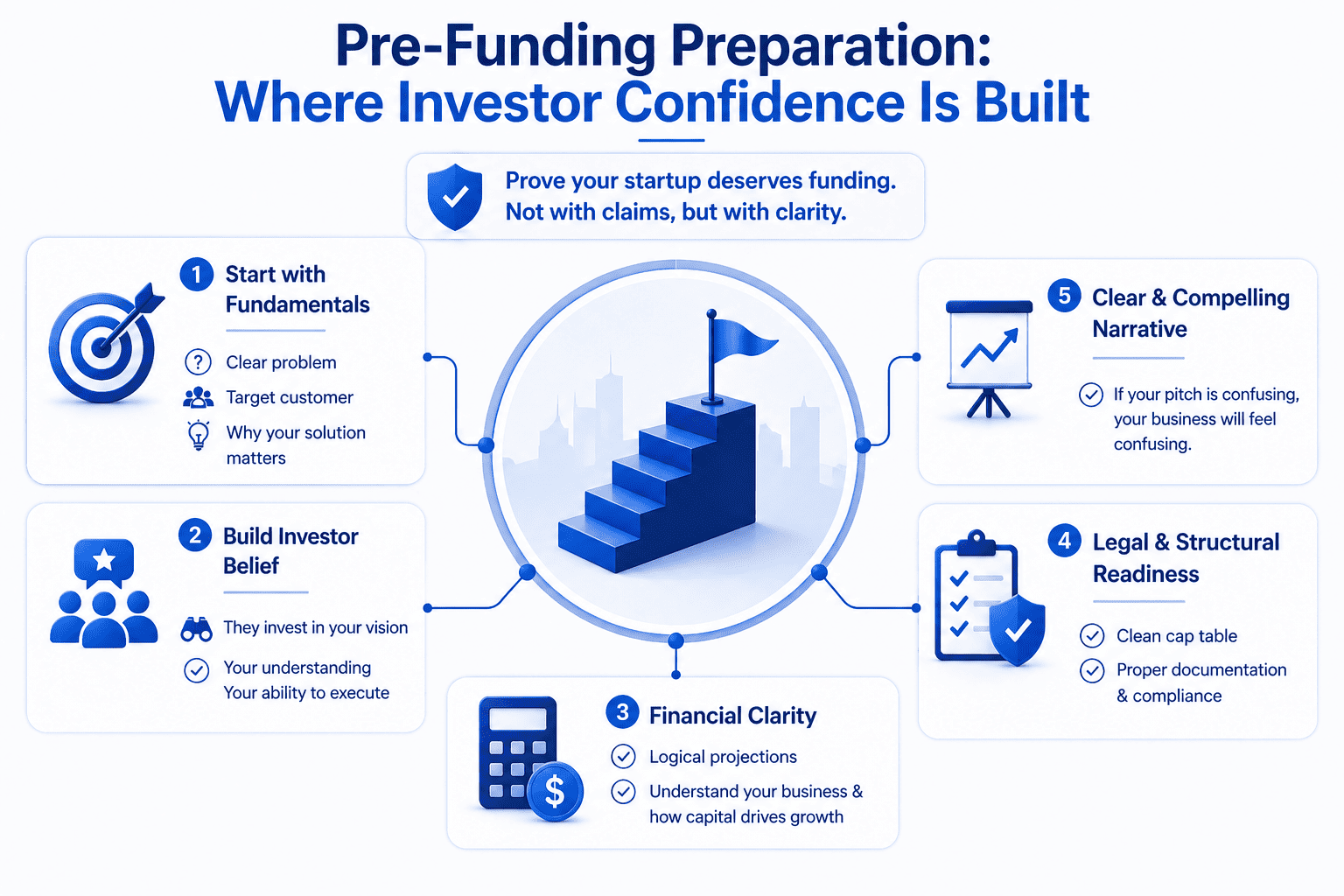 This is where your journey actually begins. Before you approach investors, your job is to prove that your startup deserves funding. Not with claims, but with clarity. Start with fundamentals.
Do you clearly understand the problem, your customer, and why your solution matters?
At early stages, investors are not looking for perfection. They are looking for belief. They invest in your vision, your understanding, and your ability to execute.
Then comes financial clarity. Your projections do not need to be perfect, but they must be logical. Investors want to see that you understand how your business works and how capital will move you forward.
Legal and structural readiness also plays a critical role. A clean cap table, proper documentation, and compliance reduce friction during due diligence. And finally, your narrative. If your pitch is confusing, your business will feel confusing. Startups that prepare deeply at this stage don’t just raise funds faster. They raise them with confidence.
Download the Complete Funding Process Guide (PDF)
Instead of trying to piece everything together, use a structured roadmap.
Use it as a working system to track your readiness across every stage.
During Funding: Where Preparation Gets Tested
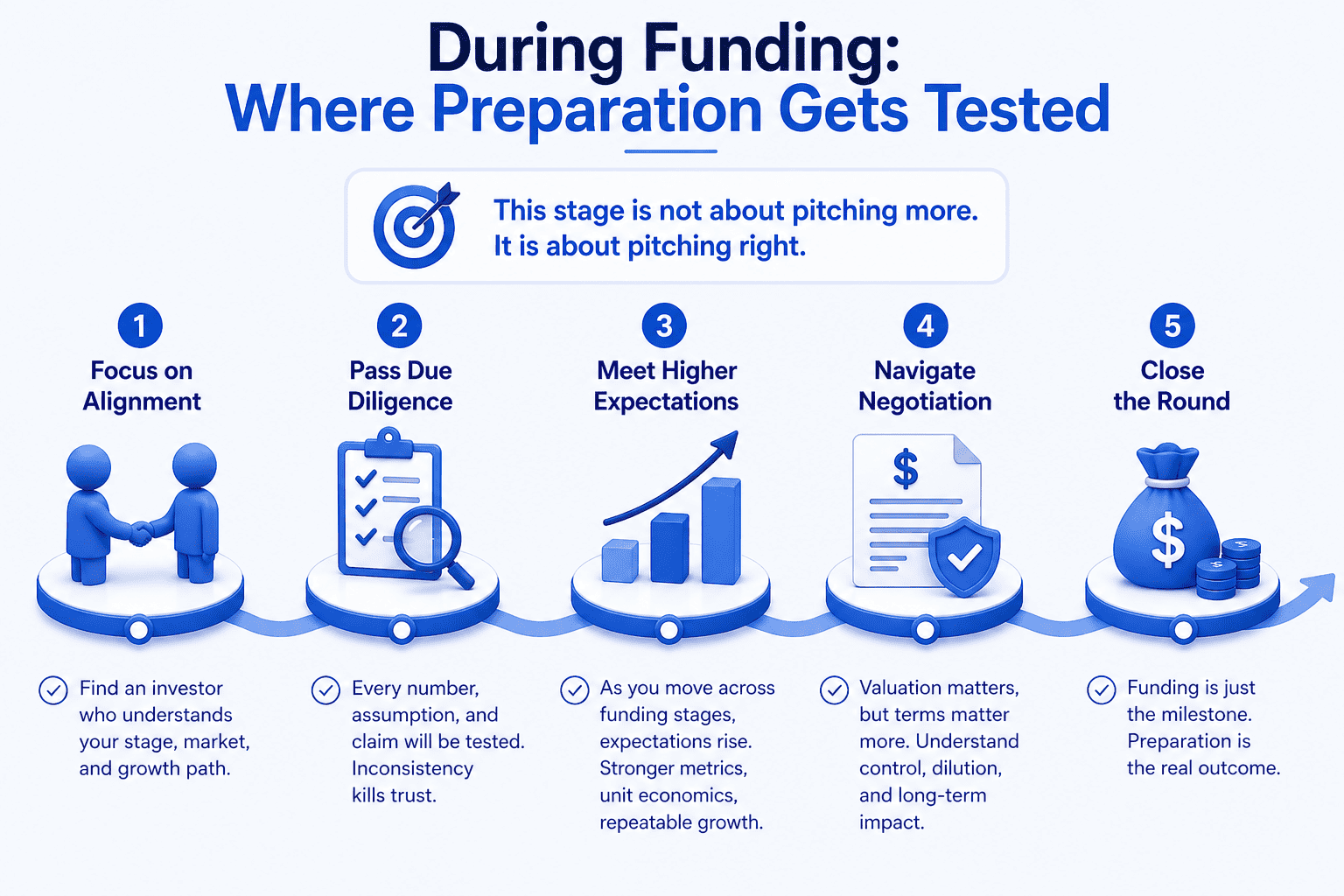 Once you start investor conversations, everything becomes real. This stage is not about pitching more. It is about pitching right.
You need to focus on alignment. The right investor is not just someone who invests but someone who understands your stage, market, and growth path. Due diligence is where your preparation is validated. Every number, assumption, and claim will be tested. If your data is inconsistent, trust drops immediately. And this is where many founders struggle. Because as you move across startup funding stages, expectations change. What worked at the seed
stage will not work at Series A. Investors now expect stronger metrics, clearer unit economics, and repeatable growth.
Negotiation is another critical moment. Valuation matters, but terms matter more. Control, dilution, and long-term impact should be clearly understood before signing anything.
This stage ends with funding. But that is not the real outcome. The real outcome is whether you were prepared enough to get here smoothly.
Post-Funding: Where Real Execution Begins
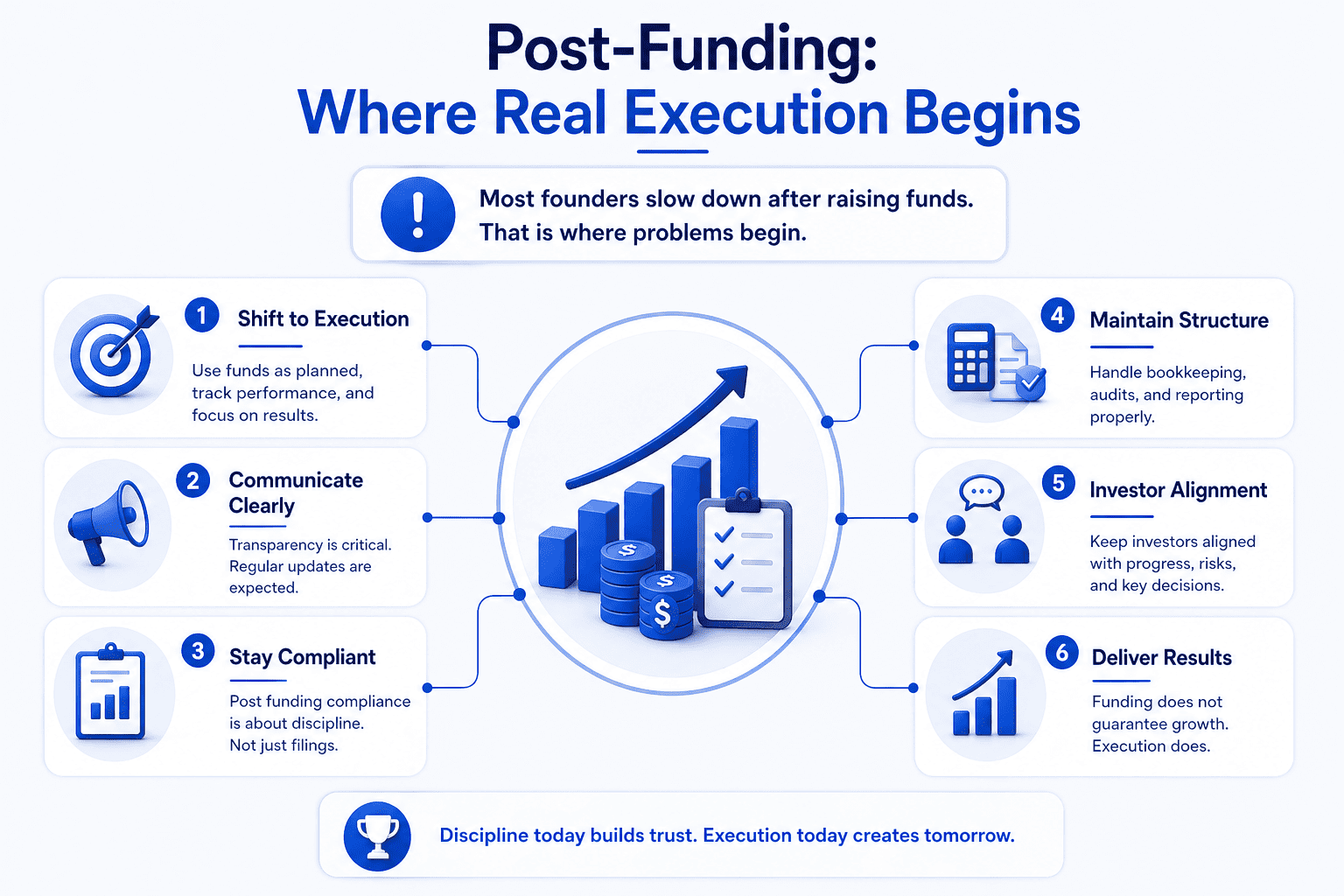 Most founders slow down after raising funds. That is where problems begin. Post funding compliance for startups is not just about filings. It is about discipline.
Now your focus shifts to execution. You must use funds as planned, track performance, and communicate clearly with investors. Transparency becomes critical. Regular updates are not optional. They are expected.
Compliance also becomes structured. Bookkeeping, audits, and reporting must be handled properly. And most importantly, you must deliver. Because funding does not guarantee growth. Execution does.
Startup Funding Stages: What Actually Changes at Each Level
To truly understand how startup funding works, you need to understand how expectations evolve.
In the early stage, investors are backing your idea and your ability to execute. At this point, traction may be limited, and that is acceptable.
As you move to seed stage, the focus shifts to validation. Investors now expect early traction, user growth, or revenue signals. By the time you reach growth stages like Series A and beyond, the expectations change again. Now it is about scalability, repeatability, and strong financial metrics.
This progression is critical. Because every funding round is not just capital. It is proof that your startup has reduced risk and earned the next level of trust.
Common Mistakes Founders Make
Approaching investors too early without proper validation
Incomplete or poorly organized documentation
Focusing only on valuation instead of investor alignment
Losing discipline after raising funds
Ignoring the importance of preparation in the funding process
Most funding challenges are internal, not external, and avoiding these mistakes is what separates prepared founders from reactive ones.
Startup Coach Perspective
At Startup Coach, we see funding differently. It is not just about pitching better; it is about preparing better. Founders who understand the complete startup funding process are able to raise capital with clarity, execute with discipline, and build long-term trust with investors. Funding should not feel like pressure; it should feel like a natural progression in your startup journey.
Conclusion
The startup funding process is not just about raising capital. It is about building readiness at every stage.
From pre-funding preparation to managing investor conversations and executing post-funding plans, each step plays a critical role in shaping your startup’s growth journey.
If you are serious about raising capital, focus on building clarity, discipline, and strong fundamentals early. The right preparation not only improves your chances of funding but also helps you secure it on better terms.
For founders looking to navigate the funding process with clarity and confidence, connect with our experts.
FAQs
Q: What is the startup funding process?
The startup funding process is the complete journey of preparing, raising, and managing capital. It includes pre-funding preparation, investor engagement, and post-funding execution, each stage reducing risk for investors.
Q: What happens in the pre-funding preparation startup stage?
This stage focuses on validating your idea, building financial clarity, and setting up legal structures. It ensures your startup is investor-ready before you start pitching.
Q: What is included in the funding process startup phase?
It includes investor outreach, pitching, due diligence, negotiation, and closing. This stage tests how well your preparation holds up under investor scrutiny.
Q: What is post-funding compliance for startups?
It involves tracking fund usage, maintaining financial discipline, meeting compliance requirements, and updating investors regularly. This stage builds long-term credibility.
Q: How does startup funding work across stages?
Startup funding works in stages where expectations increase over time. Early stages focus on vision, later stages focus on traction, and growth stages focus on scalability and financial performance.